Jaroslav Kores, Ph.D.
Why is it better to ride a bike on the road with bigger wheels than with smaller ones?
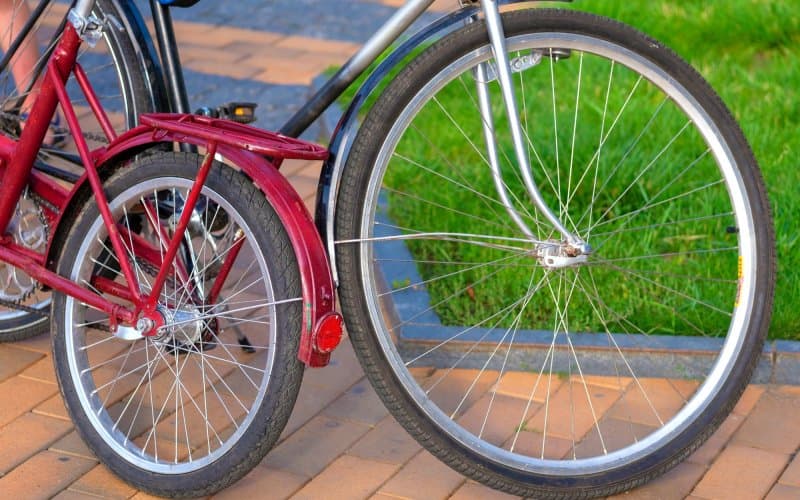
Different drag forces act against the movement of bodies, this situation is described as rolling drag. The size of the rolling drag depends on several quantities — the force that pushes the wheel on in our case, the riding surface, the radius of the wheel and the arm of the rolling drag. All these quantities describe how the wheel and the surface deform when interacting with each other. It is probably obvious that the more force we apply to the wheel, the more it will deform both the wheel and the surface.
The rolling drag arm describes how easily the material of the wheel and surface is deformable — a metal cylinder does not deform a metal pad in the same way that a metal cylinder would deform for example polystyrene. But with rolling drag, not only the surface on which the body rotates is deformed but also the body itself — an inflated wheel deforms less when riding than a deflated wheel. That's why it's a good idea to always have your tires properly inflated. The influence of the wheel radius can be clearly seen in the example of riding on a soft surface — a wheel with a smaller radius sinks into the surface more (which is related to the amount of pressure exerted by the wheel on the surface — the smaller the area on which the force acts, the greater the pressure). The larger the radius of the wheel, the less the surface is deformed due to the weight of the wheel and the load and the better the wheel will turn. Likewise, the wheel itself will be less deformed. A perfectly rigid wheel riding on a perfectly rigid surface would be ideal for riding — then the rolling drag would be zero and there would be no deformation of either the surface or the wheel itself. But unlike physics, the real world is not perfect, so the deformation of the wheel and the surface will always occur. Bearings come the closest to this situation — metal balls/rollers in a metal housing. Why don't we still ride bikes that don't have tires but just a metal casing? It would be quite uncomfortable (a rubber tire with air absorbs small shocks well) and, above all, very difficult.
More mysteries
Keep exploring questions other readers asked.

Jaroslav Kores, Ph.D.
Why can’t metal utensils be used in the microwave?
A microwave oven uses electromagnetic waves of a specific frequency for heating — 2.45 GHz. This frequency is not chosen randomly, it is the resonance frequency of water molecules. Resonance is an action in which we supp…
Read the answer
Jaroslav Kores, Ph.D.
Will a heavier body achieve a higher free-fall velocity than a lighter one (of the same size)?
I like questions that I can always get right (or always wrong but I'm an optimist).The correct answer to such a question is yes and no. If I wanted to have only one correct answer, I would have to add to the question whe…
Read the answer
Jaroslav Kores, Ph.D.
How much water evaporates in 1 hour from 1 m² of water at a temperature of 30 °C?
Unfortunately, there is no simple answer to such a simple question. The rate of evaporation of any substance depends on many factors and only a few are listed. Specifically, the rate of evaporation depends on the materia…
Read the answerWant to ask something?
Send us an e-mail with the subject "Physics mysteries" to the address below, or use the contact form.
We can't wait to tackle your interesting questions!