Jaroslav Kores, Ph.D.
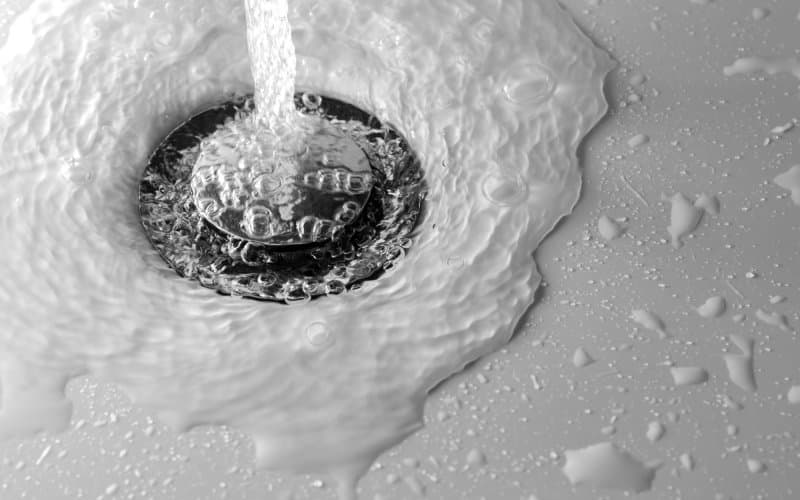
Why does the water in a washbasin spin the other way round in the northern and southern hemispheres when you drain it?
We all probably know that a lot of things that are said are not completely true.
And the statement that water in the northern and southern hemispheres always rotates in reverse when it is drained is one of them.
This question is due to the Coriolis force but we can observe its manifestations in other phenomena — e.g. the rotation of clouds or the formation of meanders in rivers — in the northern and southern hemispheres, the low atmospheric pressure rotates in the opposite direction — in the north, it is anticlockwise and in the south the low atmospheric pressure rotation is clockwise.
The Coriolis force is very small and to observe its effects we need phenomena that last long enough — certainly longer than the water draining from a bathtub or washbasin.
Therefore, if we observe the direction in which the whirlpool will turn when draining the water, the resulting direction of rotation will depend on the direction of hand movement when pulling out the plug, the movement of the water before draining or even on the shape and cleanliness of the washbasin.
The more observations of draining water, the more likely we would see that there is a slightly higher probability of a clockwise rotation of the whirlpool (if we are in the Northern Hemisphere).
Having already mentioned the Coriolis force, we should at least give it a little more detail.
This force arises in all places that rotate.
Since the Earth rotates around its axis, this force also acts on all moving bodies.
We can explain it in the way that, for example, when we throw a ball, it should move in a straight line.
However, the Earth rotates a bit during the flight of the ball and therefore the ball does not land at the place where we threw it but a little bit next to it.
Fairground attractions were based on this (I remember Lochness), where people sat on a rotating circumference and had to hit a ball into a hoop in the centre of the rotation.
In the movement of the thrown ball, it was nicely seen how its trajectory curves.
Another example is Foucault's pendulum — it is a pendulum that is freely hung and proves the rotation of the Earth — after 6 hours it oscillates perpendicular to the direction in which it originally oscillated.
The pendulum holds the direction of its swing and the Earth rotates beneath it.
Because the rotation frequency of the Earth is small, the magnitude of the Coriolis force is also very small and therefore its effect on the whirlpool when draining water is not so great that it overcomes the other forces that act on the flowing water and always turns the whirlpool in one direction.
More mysteries
Keep exploring questions other readers asked.

Jaroslav Kores, Ph.D.
What would happen to our body if we flew at the speed of light?
At first, I have to point out that only light can travel at the speed of light — mainly because it has zero weight. Anything with non-zero weight would require exactly an infinite amount of energy to accelerate to the sp…
Read the answer
Jaroslav Kores, Ph.D.
What would happen if the Earth stopped rotating?
That would probably be pretty unpleasant, I'm afraid it would almost immediately end all life on the Earth. The Earth rotates with a frequency of 1 rotation per 24 hours. By a fairly simple calculation, we can find out t…
Read the answer
Jaroslav Kores, Ph.D.
Is it possible that aliens have visited the Earth in history?
Some materials or products are said not to be "earthly". It's certainly possible, but I'm not aware of any irrefutable evidence for it. Astronomers are convinced that there must be more than 1 planet in the universe to s…
Read the answerWant to ask something?
Send us an e-mail with the subject "Physics mysteries" to the address below, or use the contact form.
We can't wait to tackle your interesting questions!