Jaroslav Kores, Ph.D.
Why do I tan more in winter than in summer?
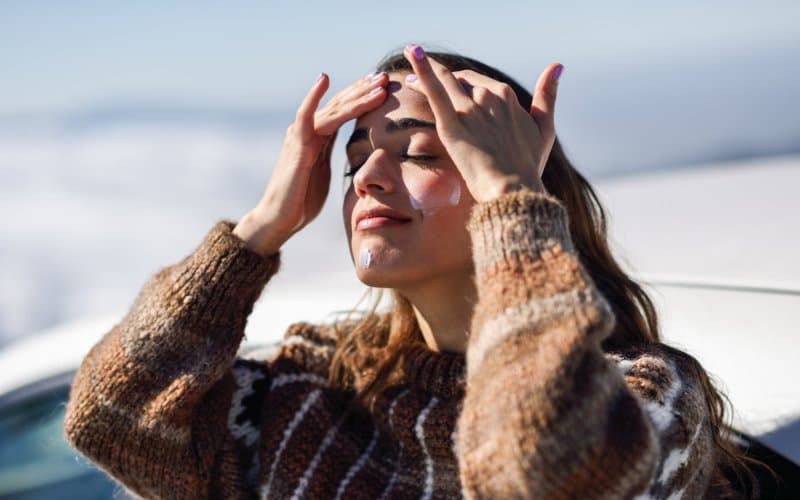
To be honest, I haven't experienced this but it's probably because I don't sunbathe much. I don't know if the winter tan is also related to the skiing/mountain activities. If this is indeed the case, I think it has two causes. The first of these is that moist air scatters UV radiation more (that is, when travelling through the atmosphere, UV radiation rays are scattered in different directions and do not hit a given surface as intensely). Due to higher temperatures in the summer, there is more evaporation, the air contains more moisture and therefore less UV rays fall on us, which causes a weaker production of melanin, which turns the skin brown.
The second effect (especially in the mountains) is that white snow reflects light and therefore UV radiation well. Our skin is therefore exposed to UV rays both directly from the Sun and reflected from the snow.
And quite possibly, we don't pay as much attention to a possible tan in the winter as we do in the summer — we typically forget to pack sunscreen in the winter.
More mysteries
Keep exploring questions other readers asked.

Jaroslav Kores, Ph.D.
Is the same person’s weight different at the equator and at the North Pole?
I don't want to be a quibbler but with this question, it is clear that it is good to use the right terms for what we want to find out. Because I could easily answer yes or no, and in both cases I would be right ...
Read the answer
Jaroslav Kores, Ph.D.
Why does heat go up and cold air go down?
It is the same as why iron sinks to the bottom in water but wood rises. We probably all intuitively know that bodies with a high density in water sink to the bottom and bodies with a low density rise to the top. And perh…
Read the answer
Jaroslav Kores, Ph.D.
Why don’t we see icy (blueish) and hot (reddish) air in different colours?
Our eye perceives only a (very small) part of electromagnetic waves and we call this part light. This wave is described by its frequency (in visible light, the frequency corresponds to a certain colour). The colour of th…
Read the answerWant to ask something?
Send us an e-mail with the subject "Physics mysteries" to the address below, or use the contact form.
We can't wait to tackle your interesting questions!