Jaroslav Kores, Ph.D.
Is it possible to travel in time?

So far it seems that time travel is limited by causality — this means that the effect can never precede the cause — I can't be full before I start eating.
Therefore, travelling to the future is real, but it is a one-way journey.
Future travel arises from Einstein's special theory of relativity — the faster we move, the slower our time passes compared to the time of our observers who are at rest (not moving).
Such travel to the future is actually simple — just get into a rocket (it doesn't have to be a rocket but any means of transport) and fly away quickly.
The faster we move, the slower our time will pass compared to the time on the Earth.
The tricky part is that our speed has to be really fast — to halve our time contrary to the time on the Earth, we would have to move at 70% of the speed of light (it is a lot indeed, for example, rockets go about 0.003% of the speed of light).
The stated principle of time travel is based on the fact that time is relative — that is, it does not flow the same for all people.
This looks strange but it has been proven many times, for example GPS satellites have to consider the relativity of time. Otherwise, their accuracy would decrease by about 10 km after 1 day!
Of course, it is a question of what use would travelling to the future be for us — for example I can think of moving the terminally ill into the future with the expectation that medicine will have a cure for their disease.
But we would definitely need to resolve all debts and health insurance.
More mysteries
Keep exploring questions other readers asked.

Jaroslav Kores, Ph.D.
Is it possible to measure “telepathic” waves (mind power) outside the body?
For example, affecting another person at a distance greater than 1 m? We have been able to measure "telepathic" waves for over 150 years — since the first electrodes were attached to the brain and thus since the first el…
Read the answer
Jaroslav Kores, Ph.D.
Is there energy left in the world after a person dies?
In the physical sense, certainly yes, in the philosophical sense, maybe also and whether in the metaphysical sense, I don't know. Since we are composed of carbon, oxygen and water, it would be possible to extract these e…
Read the answer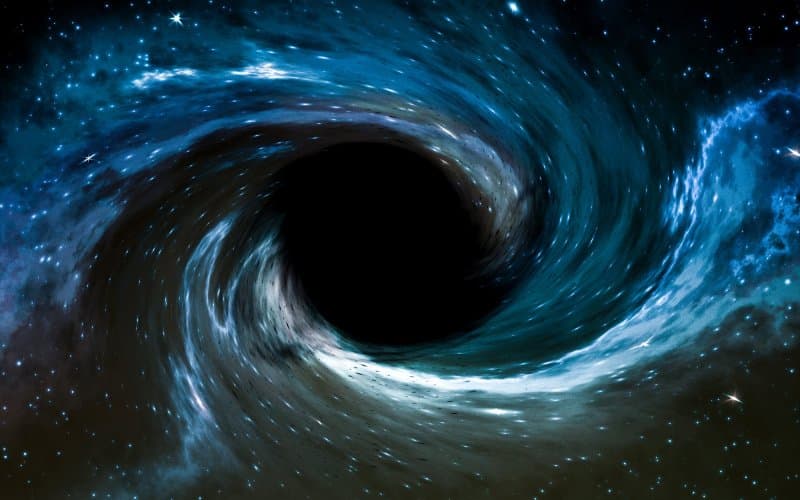
Jaroslav Kores, Ph.D.
What is a black hole and where does the “suck in” happen?
We all have the experience that when we throw something, it falls to the ground. The faster we throw an object, the further it lands. If we throw it very fast, it will not fall to the ground, but will orbit the Earth. Ho…
Read the answerWant to ask something?
Send us an e-mail with the subject "Physics mysteries" to the address below, or use the contact form.
We can't wait to tackle your interesting questions!