Jaroslav Kores, Ph.D.
How should we understand the decentralization of electricity production?
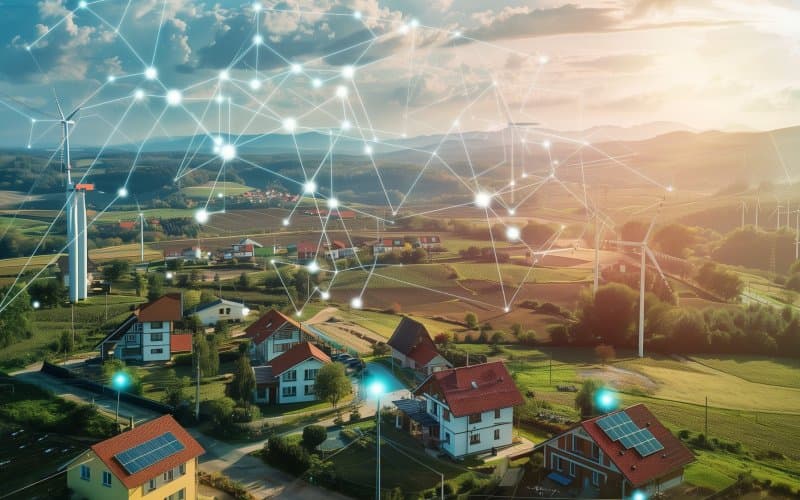
Previously, electricity generation was centralized because building a power plant was expensive in terms of finance, technology, and materials. Therefore, power plants were initially built either in locations where the relevant source for converting energy into electricity was available (mills and subsequently hydroelectric power plants, coal-fired power plants), and later large-capacity power plants were built in relatively any location.
With the rise of renewable sources and the reduction in their cost (both financial and technological), the possibilities for installing new sources have expanded. These sources have a small capacity but can cover the consumption of nearby properties.
Decentralization therefore refers to the construction of smaller power plants. The advantage of decentralization is the reduction in electricity distribution costs (we only transmit it locally, not over long distances), and there has also been a decrease in energy transmission losses.
The disadvantages depend on what we plan to do if production is greater/less than consumption. The simplest option is island operation — if production is lower, electricity simply won't be available, but this isn't realistic in most cases. Otherwise, the local network must be connected to the central network, which requires additional costs for managing the traffic on this network (the so-called smart grid). Battery storage is also an option, but it is economically expensive.
With the decentralization of electricity generation came the possibilities of energy independence and reduced electricity production costs, but paradoxically, these savings are offset by increased costs for the central transmission system. In the case of larger communities, the generated energy can be managed more efficiently, but again, at higher costs (transmission management, battery storage, consumption management of individual consumers).
More mysteries
Keep exploring questions other readers asked.
Jaroslav Kores, Ph.D.
What is a smart grid and how does it work?
With the rapid development of renewable energy sources and their connection to the transmission system, new requirements for its operation have emerged. For us as consumers, they're not really new — we expect to have ele…
Read the answer
Edita Bromova
Atom
Its name means "indivisible". This concept was introduced some 400 years before our era by the Greek scholar Democritus, who was considering whether matter could be divided indefinitely or not. He came to the conclusion…
Read the answer
Jaroslav Kores, Ph.D.
What are the most effective ways to save energy at home?
Because the largest portion of household consumption is related to heating, the most effective way is to focus on all appliances that produce heat (or remove it — air conditioning). If we want to consume as little heat a…
Read the answerWant to ask something?
Send us an e-mail with the subject "Physics mysteries" to the address below, or use the contact form.
We can't wait to tackle your interesting questions!