Edita Bromova
Does lightning always have to strike the ground?
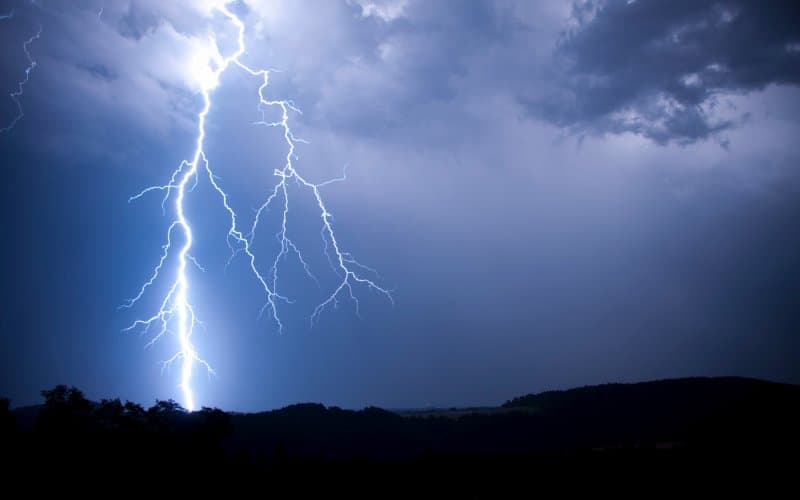
The most common way to draw lightning is a zigzag line from the cloud to the ground. However, this is not the only way lightning can strike. This relates to the rather complicated way in which lightning is produced in a storm cloud.
Even though it is made up of only water, a storm cloud is a huge structure, ranging from a few kilometres above the ground to 12 kilometres up. Some clouds can peak up to 20 kilometres above the ground! The top of the cloud reaches into the cold tropopause and is made up of ice chunks. Intense updrafts and downdrafts occur throughout the cloud. Droplets of water carried up by the upward flow collide with descending heavy chunks of ice. These are the nuclei of hail, known as graupel.
When they collide, charge is transferred by the triboelectric effect. The falling ice chunks carry a negative charge to the bottom of the cloud, while the rising droplets carry a positive charge upwards. Gradually, a large positive charge builds up at the top of the cloud, while a negative charge builds up at the bottom. Areas of separated charge can split into several other regions due to movements in the cloud.
A very strong electrical voltage is created between the charges. Because air is a poor conductor, it acts as an insulator and prevents electric current from flowing between areas of opposite charges. But when a really big charge builds up, the strength of the electric field overcomes the insulating power of the atmosphere and a lightning strike occurs.
More mysteries
Keep exploring questions other readers asked.
Edita Bromova
Can anything be lighter than hydrogen?
Hydrogen is the lightest element in the known universe. It consists of just one proton orbited by a single electron. It would seem, therefore, that nothing could be lighter. Theoretically, it would be possible to create…
Read the answer
Edita Bromova
Water is said to have been brought to Earth by comets. But where did the water in space come from?
Water is a compound of hydrogen and oxygen. A water molecule contains one oxygen atom and two hydrogen atoms bonded to it at an angle of 104.45 degrees. In order for water to appear in the universe, these two basic eleme…
Read the answer
Edita Bromova
What is done with used wind turbine blades?
Wind turbine blades are made of composites, fiberglass or carbon fibre, strengthened together with polymeric resin. They are designed to withstand harsh natural conditions. Strong winds, rain, frost, and ultraviolet radi…
Read the answerWant to ask something?
Send us an e-mail with the subject "Physics mysteries" to the address below, or use the contact form.
We can't wait to tackle your interesting questions!