Edita Bromova
Could early humans have had a nuclear reactor?
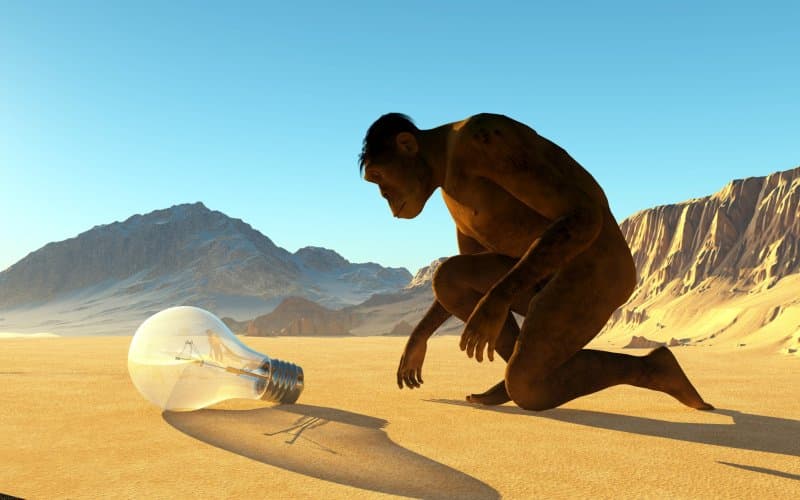
A natural reactor really existed. It was "operated" in the Oklo locality in the West African state of Gabon. The uranium ore deposits there at that time contained around three percent of the isotope 235U, which is a concentration sufficient for current nuclear reactors. In order for the fission reaction to begin, another condition was needed, namely a moderator that would slow down the neutrons flying out of the fissioned uranium nuclei to a suitable speed. The rain took care of this condition. When surface water soaked into the uranium deposit, it acted as a moderator and allowed the fission reaction to begin. Controlled by no one, the intensity of fission increased and with it the temperature of the surrounding rock, until it rose so much that the water in the fissures evaporated. By doing so, it lost its moderating ability, the slowing down of neutrons decreased and the fission reaction stopped. When the rock cooled enough and water flowed into it again, the reaction started again.
A survey of the site brought the discovery that a natural reactor had been operating here for approximately 150,000 years in a cyclical mode. After the final "decommissioning", radioactive isotopes remained in the ground, which we treat today as highly dangerous radioactive material. The analysis of the rocks showed that these isotopes, not isolated in any way and exposed to natural conditions, did not move further than a few tens of centimetres from the place of their origin.
Unfortunately, no early humans could take care of this mammoth uranium grill. The Oklo reactors operated approximately 1.7 billion years ago, at a time when single-celled life was already present in the Earth's oceans, but nearly a billion years remained before the emergence of multicellular organisms. Early humans and mammoths arrived on the scene much later, when natural reactors had long since cooled down.
More mysteries
Keep exploring questions other readers asked.
Edita Bromova
What is a photovoltaic panel doing with the sun shining on it when no one is drawing electricity from it?
A photovoltaic cell is a thin wafer of silicon modified to function as a semiconductor photodiode. When a photon hits its surface, it transfers its energy to one of the electrons, which is released from its electron shel…
Read the answer
Edita Bromova
How small can a nuclear reactor be?
The smallest amount of fissile material in which a fission chain reaction can take place is called the critical amount. Most of the neutrons produced in it during fission continue to participate in fission. This allows t…
Read the answer
Edita Bromova
What does a heat pump need electricity for?
A heat pump is actually a bit like a refrigerator. While a fridge takes heat from its interior and heats the room in which it stands, a heat pump takes heat from the external heat reservoir to heat the interior of the ho…
Read the answerWant to ask something?
Send us an e-mail with the subject "Physics mysteries" to the address below, or use the contact form.
We can't wait to tackle your interesting questions!